







How to Play Various Poker Games
Poker is an exhilarating card game in which players make bets based on who has the strongest hand. It has been played for centuries across the globe. Texas Hold’em is now the most popular version of poker by far, and the best place for beginners to start learning the game.
Although it takes a lifetime to master, you can learn the basics in 15-20 minutes with this guide on how to play poker for beginners, which covers everything from hand rankings to rules for each of the most popular poker variations.
How to Play Poker: Key Points
- Poker is a card game where players aim to make the best five-card hand.
- Learn hand rankings, betting rounds, and basic gameplay first.
- Popular variations include Texas Hold’em, Omaha, and Five Card Draw.
- Master poker etiquette to maintain game integrity.
What Is Poker?
Poker is a card game in which players make bets based on who has the strongest hand.
You can win the pot by either having the best five-card combination at showdown or when all other players fold. Poker games are played with a standard 52-card deck, and most formats accommodate 2–10 players per table. Poker is a game of part chance and part skill. You can’t control the cards you are dealt.
What you can control is which hands you play, as well as the bets you make (or don’t make).
It’s easy enough to learn how to play poker, although mastering strategy is profoundly complex. Here, we’ll discuss Texas Hold’em in detail and review the poker rules for other games, such as Omaha, Seven Card Stud, and Five Card Draw.
How to Play Poker: The Rundown
Soon, we’re going to take you through every aspect of how to play poker in more detail. First, here’s a quick rundown on the game:
- Set up the table and chips: Poker is played on a table. If you’re at home, set up your table and chairs, then distribute chips to each player.
- Place blinds: In the popular poker games like Texas Hold’em and Omaha, the two players to the left of the dealer place compulsory bets, known as the small and big blind.
- Deal the cards: Choose a dealer or take turns dealing the cards. In Texas Hold’em, each player receives two initial private cards, known as hole cards. The cards are dealt one at a time in a clockwise direction, starting with the player to the dealer’s left.
- Betting rounds: There are four betting rounds in Texas Hold’em: preflop, the flop, turn, and river. On each betting round, players decide whether to check, bet, fold, call, or raise, depending on the action in front of them.
- Showdown: If two or more players are still in the pot after the final betting round on the river, the cards are flipped over to see who has the best hand. This is known as the showdown.
- Winner takes the pot: Whoever has the strongest five-card combination according to the poker hand rankings wins the chips in the middle, known as the pot.
Poker Hand Rankings Explained
When playing poker, you’re looking to make the strongest five-card combination possible using the available cards. Depending on the poker variant, this can involve using both private hole cards and community board cards.
So, when learning how to play poker, your first step will be to familiarise yourself with the poker hand rankings. Thankfully, they are the same across many of the most popular variants. All four suits are equal in value; there is no suit hierarchy for comparing hands.
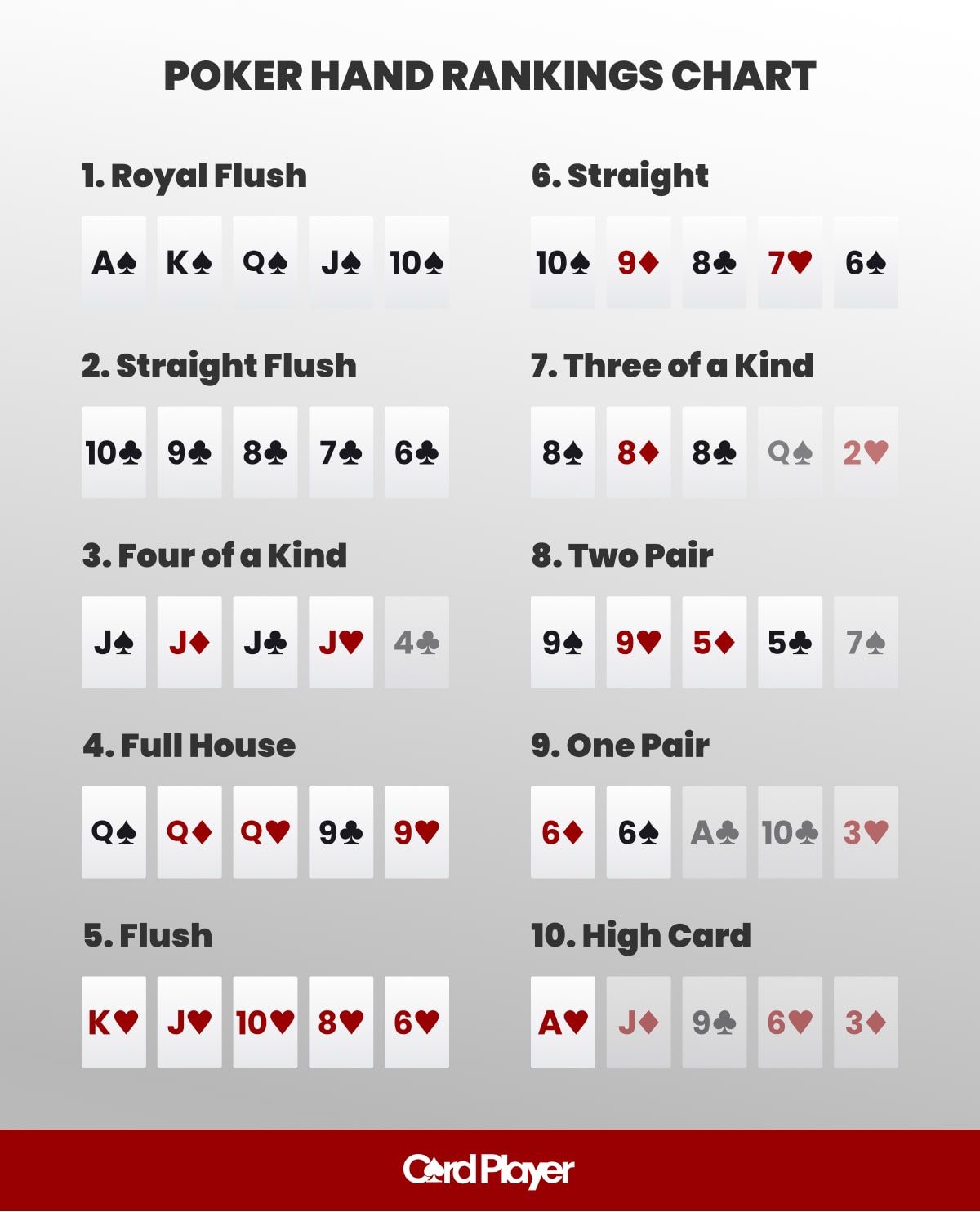
The best hand you can make in Texas Hold’em and other poker games is a Royal Flush, while the lowest is a High Card. There are ten types of five-card poker hands. Here is a chart of the poker hand rankings, from strongest to weakest:
Lowball Poker Hand Rankings
In lowball poker games, such as 2-7 Triple Draw and Ace to Five, poker hand rankings are reversed, so the lowest five-card combination wins the pot. The exact lowball rankings differ by variant, for example:
- Deuce-to-Seven Triple Draw: the best hand is 7-5-4-3-2 (off-suit); straights and flushes count against you, and Aces are high.
- Ace-to-Five Lowball: the best hand is A-2-3-4-5 (wheel); straights and flushes are ignored.
How Poker Betting Works
On each betting street, depending on the action so far, players have the option to check, fold, call, bet, or raise. In Texas Hold’em poker rules, there are four betting rounds: preflop, flop, turn, and river.
- Fold: If at any point during the hand you don’t want to match the current bet or raise size, you can get rid of your cards, known as folding. You will forfeit any chips already bet and can no longer win the hand.
- Check: If no bet has yet been made during the round, you have the option to check. You bet no chips and instead pass the decision over to the next player. Checking is not an option if bets or raises have already been made.
- Bet: A bet is the first wager made by a player during a betting round. All other players must at least match the bet to stay in the pot.
- Call: Matching the current bet or raise size to stay in the hand.
- Raise: When someone has already bet, you can raise by putting more than the required amount in the middle, further inflating the pot and requiring others to match the new size.
Pro Tip: Betting is one of the most strategically important elements of poker. It’s something that you have control over. You can’t choose the hands you are dealt, but you can choose how to play them, when to bet, and how much to bet.
How to Play a Poker Hand (Step-by-Step Example)
Here we’ll take you through an example hand, so that by the time you read this, you’ll know how to play poker all the way to showdown.
Blinds and Antes
Most poker games, such as Texas Hold’em and Omaha, begin with players posting their blinds. These are compulsory bets made before the cards are dealt to create a pot.
The player to the left of the dealer posts the small blind, and the player to their left posts the big blind. The dealer button moves around the table, so players take turns in each position. Antes may also be used, which are smaller compulsory bets paid by everyone at the table.

Example: The blinds are posted. You are dealt Ac Ad on the button, a dream situation!
Preflop Betting Round
Preflop action begins with the player to the left of the big blind and proceeds clockwise around the table. Each player takes turns checking, folding, calling, betting, or raising.
Example: The action folds around to you on the button. You raise, and only the player in the big blind calls.
Flop
In community card games like Texas Hold’em and Omaha, three cards are dealt face-up on the flop that are shared between all players. This is followed by a round of betting. Postflop, the first active player to the left of the dealer starts.

Example: The flop comes Ks 5d 3c, an excellent flop for your pocket aces. The big blind checks, you bet, and they call.
Turn
Another single community card is dealt face-up, known as the turn. This is followed by the third round of betting. Again, the first active player to the left of the dealer starts the action.
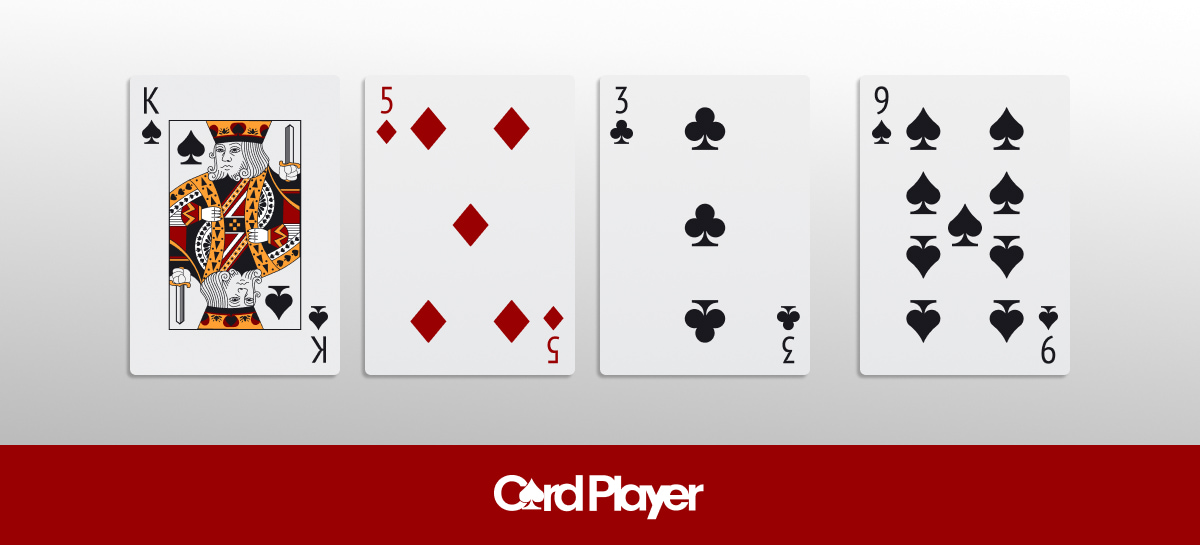
Example: The turn is the 9s, a good card for your hand, although it does bring possible draws. The big blind checks, and you bet big, which they call.
River
A final community card is dealt face-up, known as the river. This is followed by the last opportunity to bet in the hand.

Example: The river is the Ts, not the worst card in the deck for you, but it does complete some draws. The big blind leads out with a small bet, and you decide to call to go to showdown.
Showdown
If two or more players are left in the pot after the final betting round is complete, the hand goes to showdown. The remaining players reveal their cards, and the player with the strongest five-card combination wins the pot.
In the event that two or more players have the same strength hand, the player with the highest kicker wins the pot. If two or more players have identical hands, the poker rules state that the pot is split.
Example: The big blind shows Kd Js for a pair of kings. You are ahead with your pocket aces and win the pot.
Poker Game Types Explained
Each poker game variation comes with its own set of rules, gameplay, and strategy. Here’s an overview of how to play poker for four of the most popular games.
How to Play Texas Hold’em
In Texas Hold’em, players are dealt two hole cards, followed by a total of five shared community cards over the course of the hand. The aim is to make the strongest five-card hand using any combination of hole cards and board cards.
Players place blinds and sometimes antes. There are then four betting rounds: preflop, flop, turn, and the river. When learning how to play poker, this is the place to start.
Often played with no betting limits, Texas Hold’em poker strategy is about hand selection, position, and selective aggression with both strong hands and bluffs.
How to Play Omaha Poker
In Omaha poker rules, players are dealt four instead of two hole cards.
Aside from the hole cards, Omaha poker follows similar poker rules to Hold’em. Five community cards are dealt, three on the flop, one on the turn, and the final card on the river. There are four betting rounds, one preflop and three postflop.
Players aim to make the best five-card combination according to the poker hand rankings.
In Omaha, you must use exactly two of your four hole cards, along with three community cards, to make the hand. Omaha poker is most often played as a Pot Limit game, restricting maximum bets to the size of the pot. This makes it less likely that all the chips will go in the middle preflop, although it’s still easy to build sizable pots across multiple betting streets.
Learning how to play Omaha poker is more complicated than Texas Hold’em, because there are a lot more hand combinations to think about. Hand selection is based on finding combinations that work well together, while strategy is draw-heavy.
How to Play Seven Card Stud
Seven Card Stud is a very different kind of game from Omaha and Hold’em, as there are no community cards. Instead, players are each dealt a total of seven cards over the course of the hand, some face up, and some face down.
The first round of betting starts with a forced bet by the lowest upcard, who also has the option of opening for a full bet. On subsequent betting rounds, the player with the highest visible upcard initiates the action.
There are five betting rounds in Seven Card Stud, and the game is nearly always played with a fixed betting limit. The strategic elements come from the fact that some cards are face up, allowing you to see some of your opponent’s cards and read the board when making decisions.
How to Play Five Card Draw
Five Card Draw is another good place to start for beginners learning how to play poker.
It’s the simplest variation, with only two betting rounds. Again, the aim is to make the strongest five card combination, this time by discarding and redrawing cards. Players are dealt an initial five cards, followed by the first round of betting. Then, the redraw begins, and everyone has the chance to discard any number of cards in exchange for new ones to form their hand.
This is followed by a final round of betting.
Five Card Draw is among the easiest poker games to learn, but it still offers a lot of strategy. You’ll need to play the right hands, use position wisely, and understand whether you have the pot odds to call bets.
Poker Betting Structures & Limits
Poker rules vary when it comes to betting structures and bet limits. For example, Texas Hold’em is usually played as a No Limit game, whereas Omaha poker is often Pot Limit.
Here’s an explanation of the main types of poker rules around betting structures:
- No Limit: The first bet must be at least the size of the big blind, and there is no maximum bet. Thereafter, any raise must be at least as large as the previous bet or raise, up to a player’s entire stack (“all in”).
- Pot Limit: In Pot Limit poker games, the maximum bet is capped by the size of the current pot. Bets can still get big, but overbets are impossible, and it’s not always possible to move all in, especially preflop.
- Fixed Limit: In Fixed Limit poker games, players can only bet or raise by predetermined stakes (e.g., $2/$4). During the first two betting rounds, bets and raises use the “small bet” (e.g., $2); during the final rounds, they use the “big bet” (e.g., $4).
- Spread Limit / Capped betting: Bets and raises may be any size within a defined range (e.g., $1–$5).

You’ll need to adapt your poker strategy depending on the betting structure of the game you are playing. For example, bluffing is essential in No Limit games, where you can apply pressure with large bets. In Fixed Limit games, it’s difficult to generate that kind of pressure. Instead, pot odds and draws take centre stage.
Playing Poker With or Without Chips
In its purest form, poker is a game that is played for real money.
This is what makes each decision so heart-racing and crucial. The money is represented by chips, either directly in cash games or as a chip stack in tournaments. It is possible to play poker without exchanging any real money. We still recommend using poker chips so you can bet or raise. If you don’t have chips, you can use coins or tokens instead.
Playing for fun like this is an excellent way for beginners to learn how to play poker without the pressure of a casino environment.
How to Play Poker Online vs. Live
Playing poker online and playing it live share similarities in many ways.
The main rules are the same, and so is the basic gameplay. Many of the skills are certainly transferable. There are definitely differences between the two, from the speed of the game to physical tells and the psychology of bluffing. Let’s look at some of the key differences:
| Aspect | Online Poker | Live Poker |
| Game speed | Very fast dealing and action | Slower pace, more time per hand |
| Volume and multitabling | Can play many tables at once | One game at a time |
| Game selection | Wide choice, easy to switch | Fewer tables, limited variety |
| Physical tells | Not present, only timing patterns | Visible body language and behavior |
| Online tools | HUDs and stat trackers allowed | No software or aids permitted |
| Psychology | Less pressure when clicking | Putting in chips can feel riskier |
| Experience | Convenient, fast-paced solo play | Sociable, shared room experience |
| Comfort | Play from home or anywhere | Must travel and stay present |
Poker Etiquette
If you’re going to play live poker, it helps to be aware of poker etiquette and expectations around how you should behave.
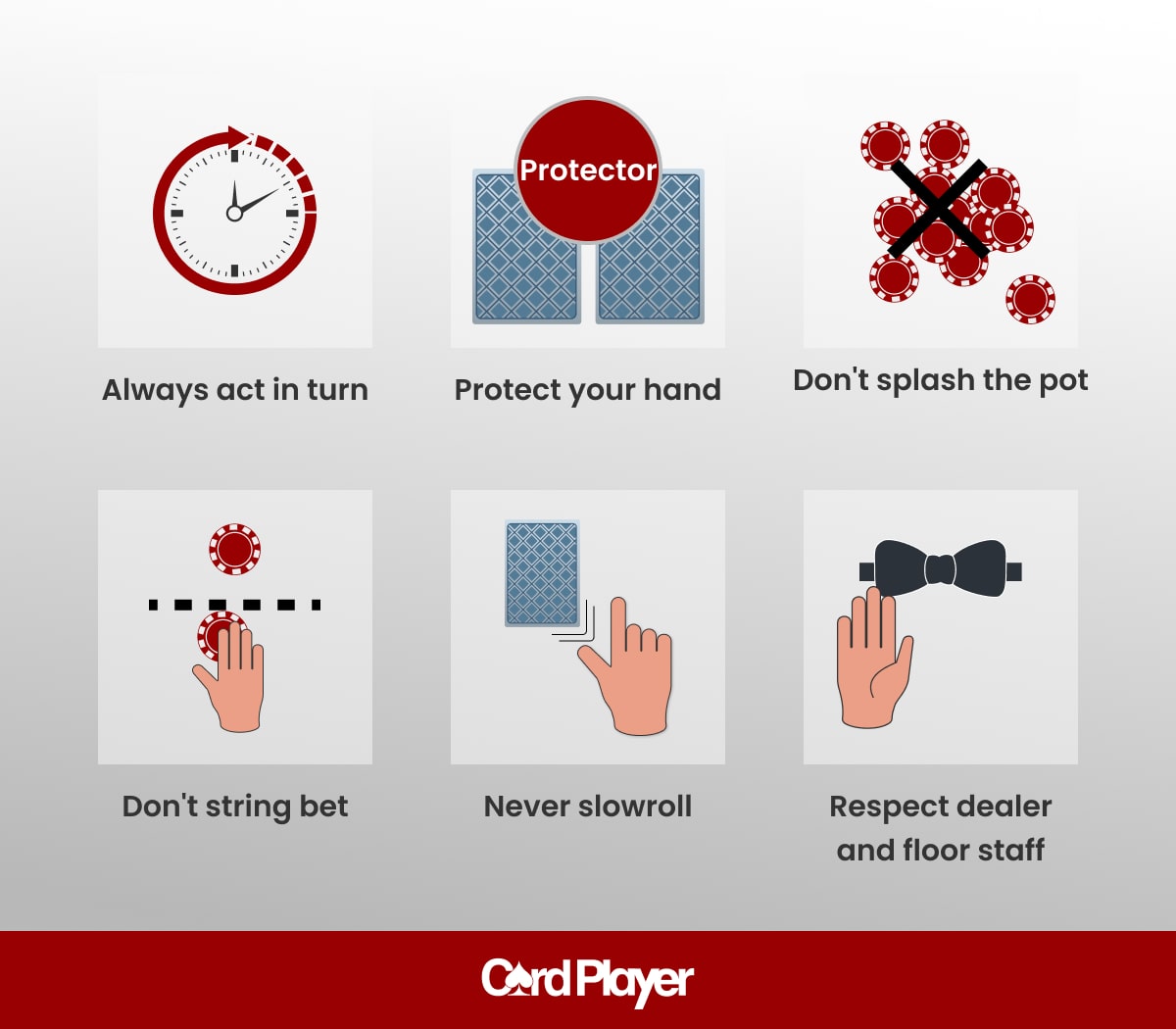
Always act in turn
Take your action when it is your turn, never before. Try not to keep everyone waiting by taking too long to review your cards or make basic preflop decisions.
Protect your hand
Don’t reveal your cards to other players, either purposefully or accidentally. Peel them carefully so that only you can see. It’s also your duty to keep your cards protected from the muck. Some players place card protectors on top of their hole cards to serve this purpose.
No string betting
Raising in multiple motions without declaring the full amount is known as string betting and is prohibited due to the risk that it can be used to elicit reactions and gain information from opponents.
Don’t splash the pot
Throwing chips messily into the center of the table is also not permitted as it obscures bet sizes and slows play.
Don’t talk about hand strength
Never discuss the strength of your hand or someone else’s hand while other players are still in the pot, even if you’ve folded. The only time this is acceptable is when the action is heads-up—just you and one opponent.
Respect other players
Basic respect should be the norm, whatever the activity, and the same is true in poker. Be friendly and courteous to other players. Even if you lose a huge hand to a bad beat, keep your emotions in check and stay calm.
Respect staff
The dealers work hard to keep poker games flowing. If a dispute arises, the casino floor staff will be contacted, and their decision is final. Always treat staff with respect.
Don’t slow roll
Deliberately delaying the reveal of a winning hand in live play is known as slow rolling, and is considered very disrespectful.
Pro Tip: If you think that poker etiquette is not important, try playing at the casino near me. Players act out of turn, shout at each other every time they experience a bad beat, and the floor doesn’t seem to enforce the rules. It’s not enjoyable. Compare this to a well run venue where etiquette is understood and enforced; you’re looking at two completely different games.
Common Mistakes New Players Make
Poker is a relatively easy game to learn, but poker strategy is incredibly complex and difficult to master.
Here are some common mistakes that new players make:
- Not learning the basic poker rules.
- Playing too many hands preflop.
- Disregarding position.
- Ignoring pot odds.
- Overvaluing weak hands, such as aces with weak kickers.
- Slowplaying strong hands and missing value.
Avoiding these mistakes is crucial, but knowing how to improve poker skills goes beyond simply playing error-free poker. The best players actively work on their game through hand reviews, studying opponent tendencies, and understanding advanced concepts like ranges and board textures.
Is Poker Hard for Beginners?
Learning the basic rules of poker is easy for beginners.
What’s difficult is moving up in stakes and competing with the best players out there. If you’re serious about how to get better at poker, you’ll need to invest time, effort, and dedication into studying strategy and analyzing your gameplay.
If you’ve followed this guide, you should be ready to at least take part in a fun home game or try your hand at online poker tournaments, starting with freerolls to build experience risk-free.
How to Improve Poker Skills
Ultimately, learning how to play poker is about more than just the basic rules and poker hand rankings.
As you gain experience, you’ll want to develop your strategy so that you can compete against other players and improve your win rate. You can start right here with some great CardpPlayer poker strategy articles. You can also watch video content online, such as on YouTube or Twitch, where pros regularly stream their poker sessions.
If you want to learn how to play poker in an advanced way, training courses and online poker schools are the way to go. You can also analyze your own gameplay using solvers, which can help you to really fine-tune your game.
If you’d like to go further with your study, check out the excellent Cardplayer resources on offer, including our extensive library of videos on YouTube. This Cardplayer video on five tips for how to improve at poker fast is a great place to start.
Conclusion
Learning how to play poker is pretty straightforward. Once you know how to play one format, it’s fairly easy to switch to another by studying the specific nuances of each. What is more difficult is progressing on the journey to mastering your game of choice. In the meantime, you can read, watch videos, take training courses, and of course, practice by playing yourself at the lower stakes.
FAQs
What are the basic rules of poker for beginners?
In Texas Hold’em, players are dealt two hole cards, along with five shared community cards across the course of the hand. There are four betting rounds, and the aim is to make the strongest five card poker hand.
Is poker hard for beginners?
Learning the basics of how to play poker is not difficult for beginners. The rules and hand rankings take only minutes to learn. Poker strategy, however, takes a lifetime to master.
Which is the simplest poker game to learn?
Five Card Draw is arguably the easiest poker game to learn, while Texas Hold’em is less complicated than games like Omaha. There is also a lot of information and many resources available to learn how to play Texas Hold’em poker.
How to understand poker hand rankings?
Many popular poker variations use the same hand rankings. There are ten types of poker hands. In order of strength, they are Royal Flush, Straight Flush, Four of a Kind, Full House, Flush, Straight, Three of a Kind, Two Pair, One Pair, High Card.
What is the beginner’s strategy for poker?
A beginner’s strategy for poker is to play a tight-aggressive style. This involves playing a solid range of starting cards while taking aggressive lines such as betting and raising.
Is poker luck or skill?
Poker is a game that combines elements of skill and chance. In the long run, a player’s skill can lead them to better results. In the short term, anything can happen.
Is poker really just math?
Poker is fundamentally a game of maths and probability. Concepts like pot odds and equity are direct examples. Poker also involves psychology and other traits, such as patience and emotional control.